
As winters become shorter and more mild, Lake Ontario is undergoing a significant shift in how its waters mix each year. This shift is reducing the amount of time the lake spends turning over in spring – a critical process that redistributes oxygen, nutrients, and heat throughout the water column. Because these physical processes help support the lake’s food webs, continued warming could have important ecological consequences across the entire lake ecosystem.
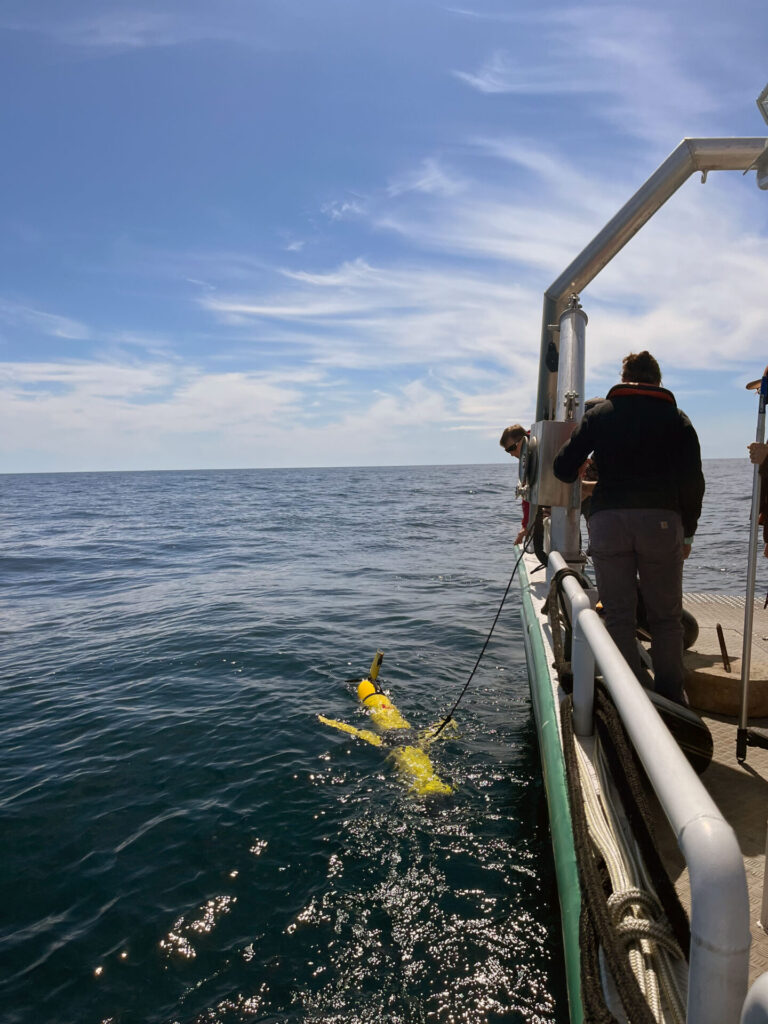
Fortunately, a novel research approach using autonomous underwater vehicles to collect detailed information from the water column is providing an unprecedented view of how the lake transitions from winter conditions into spring. These Slocum gliders provide continuous measurements over large areas and transmit those observations in near real time. Combining these detailed measurements with multiyear data from long-term monitoring stations and historical satellite observations is helping scientists understand exactly how and when these changes are occurring.
Researchers have long recognized the connection between winter temperatures and spring mixing in Lake Ontario. Winter conditions, in particular, influence thermal structure, nutrient cycling, and aquatic communities that develop during the growing season. In recent years, the lake’s central waters have not cooled below 4°C, a critical threshold that has historically driven spring mixing. And although winter and early spring are among the most important seasons for shaping conditions in the Great Lakes, they remain the least studied because harsh weather, ice, and the sheer size of the lakes make it difficult to collect data during this period.
Article continues after videos
“Recent analysis of long-term data suggests that climate change is fundamentally altering how Lake Ontario functions, which could compromise the health of the lake ecosystem and the services they provide and affect the organisms that live there,” according Dr. Mathew Wells at the University of Toronto Scarborough. “Spring turnover in the lake is critical for circulating nutrients and supporting the food webs and organisms in the lake. This process is a defining feature of temperate Canadian lakes, particularly our Laurentian Great Lakes.”
To better understand these changing conditions, Dr. Wells has been studying Lake Ontario’s thermal mixing regime using data collected from 7 long-term monitoring stations between 2021 and 2025, together with historical satellite observations dating from 1965 to 1995. Although these datasets revealed long-term trends, they could not capture how conditions varied across the lake. To fill this gap, Lydia Paulic, Glider Technician, Real Time Aquatic Ecosystem Observation Network (REAON), University of Windsor, deployed a Slocum autonomous underwater glider in Lake Ontario from May 13 to June 16, 2026. During its 36 day mission – one of the longest to date in the Great Lakes – the glider traveled 868 kilometres from the northern shore near Quinte Isle while repeatedly profiling the water column to depths of 100 metres. The glider carried high-precision sensors that measured temperature, salinity, dissolved oxygen, chlorophyll, and coloured dissolved organic matter every second, transmitting observations in near real time.
“Gliders provide spatial coverage of large lakes that scientists cannot obtain by putting out instruments or sending people out to collect data,” said Paulic. “The data from the gliders provides us with a much better understanding of temperature changes in these large lakes.”
The combined results have helped confirm that Lake Ontario is shifting toward a new thermal mixing regime. In colder winters, when water temperatures fall below 4°C, the lake experiences two distinct mixing events – one in autumn and a second in spring driven by surface warming. In warmer winters, when temperatures remain above 4°C, the spring mixing event is largely absent, leaving only autumn turnover.
Although Lake Ontario still cools below 4°C in most years, both air and water temperatures are continuing to rise, making warm winter conditions more likely in the future. In general, all the recent winters have been warmer on average with some year-to-year variability. For example, last winter, 2025-2026, was colder than recent trends, so it took longer for lake waters to warm above 4°C in spring; whereas, the previous winter, 2024-2025 was about average and winters 2023-2024 and 2022-2023 were warmer than normal, during which temperatures barely dropped below 4°C. As these warmer conditions become more common, reduced spring mixing could have significant effects on nutrient availability, biological productivity, and the health of the lake’s food web.
Studies from the 1980s found that colder end-of-winter water temperatures were closely linked to the timing of spring overturn, when the water column becomes fully mixed after warming above 4°C. Historically, winter cooling lowered deep water temperatures below 4°C, the temperature at which freshwater reaches its maximum density, allowing the lake to develop inverse stratification before spring warming triggered a second mixing event. However, satellite observations and field measurements now show that in unusually warm years parts of the central lake never cooled below this threshold, resulting in little or no inverse stratification and a much shorter spring mixing period.
Glider missions provide the data needed to address the impacts of climate change by informing management and conservation efforts. Future scheduled work include a search for yellow perch in Lake Erie in mid-July and a hydroacoustic survey in Lake Nipigon for over two weeks in late August to help assess fish populations in remote lakes. In addition, gliders will be deployed in Parry Sound, Lake Huron and Lake Michigan as part of larger ecosystem projects. Each of these efforts and their findings have implications for other lakes too, which is why these missions are so important. RAEON, led by Dr. Aaron Fisk, University of Windsor, is part of the Global Waters Futures Observatory, the largest freshwater research network in Canada, based at the University of Saskatchewan and including 12 universities in Canada.
